
Missionary museums: A Historical Perspective
The history of missionary museums and collections in Germany dates back to the colonial era. This period witnessed not only the colonisation of overseas regions by Europeans but also the presence of missionaries sent by the Catholic and Protestant churches. These missionaries had a dual objective: to spread Christianity among the native populations and to collect ethnological objects from these regions. These objects were then transported back to Germany, where numerous museums were established during the 19th century to house them.
Originally, these collections served as preparation tools for future missionaries, helping them to familiarise themselves with the cultures they would encounter. However, it soon became evident that these ethnological artefacts held a broader appeal and were of significant interest to the general public. Today, Germany still has approximately 80 of such museums, although many of them are relatively small and located within monasteries.
Unfortunately, much of the valuable context and information about these objects was not adequately documented at the time of their collection. Consequently, a significant portion of these artefacts remains shrouded in mystery within museum collections. Many individuals and organisations are advocating for these museums to engage in thorough provincial research to rectify historical injustices done by the activities of the missionaries, which often included the appropriation and mishandling of sacred and sacrificial objects by relocating them to Germany for public display. However, a more detailed discussion of these issues will follow later in this discourse. („Mission im Museum. Dekolonialisierung.“ Deutschlandfunk. Web. 03 Nov 2023. [https://www.deutschlandfunk.de/dekolonisierung-mission-im-museum-100.html])
Franciscans and their missionary work
To gain a better understanding of the museum’s composition, let’s delve into the role of the Franciscans, particularly the Franciscan missionaries who played a pivotal role in its establishment. These missionaries followed a distinct branch of Catholicism, stemming from the thirteenth-century Italian reform movement initiated by St. Francis of Assisi. This movement centered on principles that emphasised caring for the impoverished and marginalised, promoting fraternity, embracing a life of poverty supported by alms, and dedicating one’s existence to the church through an ascetic lifestyle. Despite the stringent nature of these rules, the Franciscan movement gained widespread popularity and played a significant role in religious reform in late medieval Europe.
However, in the nineteenth and early twentieth centuries, the priorities of the Franciscans shifted toward the goal of Christian conversion, particularly in non-European regions. These early Franciscan missionaries were often celebrated as courageous individuals who ventured into untamed territories, sacrificing themselves to spread Christianity among indigenous populations. They perceived the waning religiosity in Western Europe as an opportunity to establish Christianity in far-flung lands where pagan religions prevailed. Nevertheless, their motivations were not purely altruistic. In addition to spreading Christianity, they aimed to impose what they viewed as European civilization on cultures and religions they considered uncivilised.
Their efforts included practices like dressing indigenous peoples in European-style clothing and providing Western education through missionary schools. In doing so, they often marginalised indigenous knowledge, replacing traditional shamanic practices with Western medicine, believing it to represent progress and civilization. (Langer, 2009, p. 61ff)
The first official organisation of the German mission was the “Franziskaner-Missions-Verein,” founded in 1907 in Werl, just two years before the inauguration of the museum’s first collection. This organisation, led by the Franciscan Wenzelaus Strausfeld OFM, initially focused on constructing and maintaining the Franciscan Shangdong mission in China, with the primary aim of converting the Chinese people to Christianity. When they were expelled from China in 1948, they redirected their efforts to Japan and Brasilia, where they established a new Franciscan mission organisation in 1951. Their primary mission shifted after World War II, focusing on aiding the impoverished and oppressed, combating hunger and starvation, and engaging with and learning from diverse cultures and peoples.
Today, they initiate and support projects not only in China but also in Northeast Brazil, East Africa, and Vietnam. („Über uns.“ Fransiskaner Mission Dortmund. Web. 03 Nov 2023. [https://www.franziskanermission.de/?q=node/2])
Forum der Völker in Werl
The Forum der Völker Museum, located in Werl, North Rhine-Westphalia, Germany, is a museum collection with its origins in the Franciscan Abbey.
Established in 1909 in Dorsten, the museum was reconstructed in 1962 after being destroyed during World War II. It was later relocated to Werl and currently houses a collection of over fitfteen-thousand objects from outside the European continent (6.300 from the colonial context, 3.400 coins), including art and artefacts from East Asia, Africa, the Americas, Oceania, and the Middle East, all displayed across more than 1,000 square meters of exhibition space.
These objects were collected by about 95 missionaries and sisters and 16 monasteries or church institutions, or in some cases were purchased or donated by private collectors as Ernst Majonica, who brought the objects from Gandhara to Germany. (Information from the museums offcial flyer, p. 1)
Despite undergoing multiple renovations and reorganisations since 1987, the museum is currently closed due to various reasons, mainly due to financial constraints.
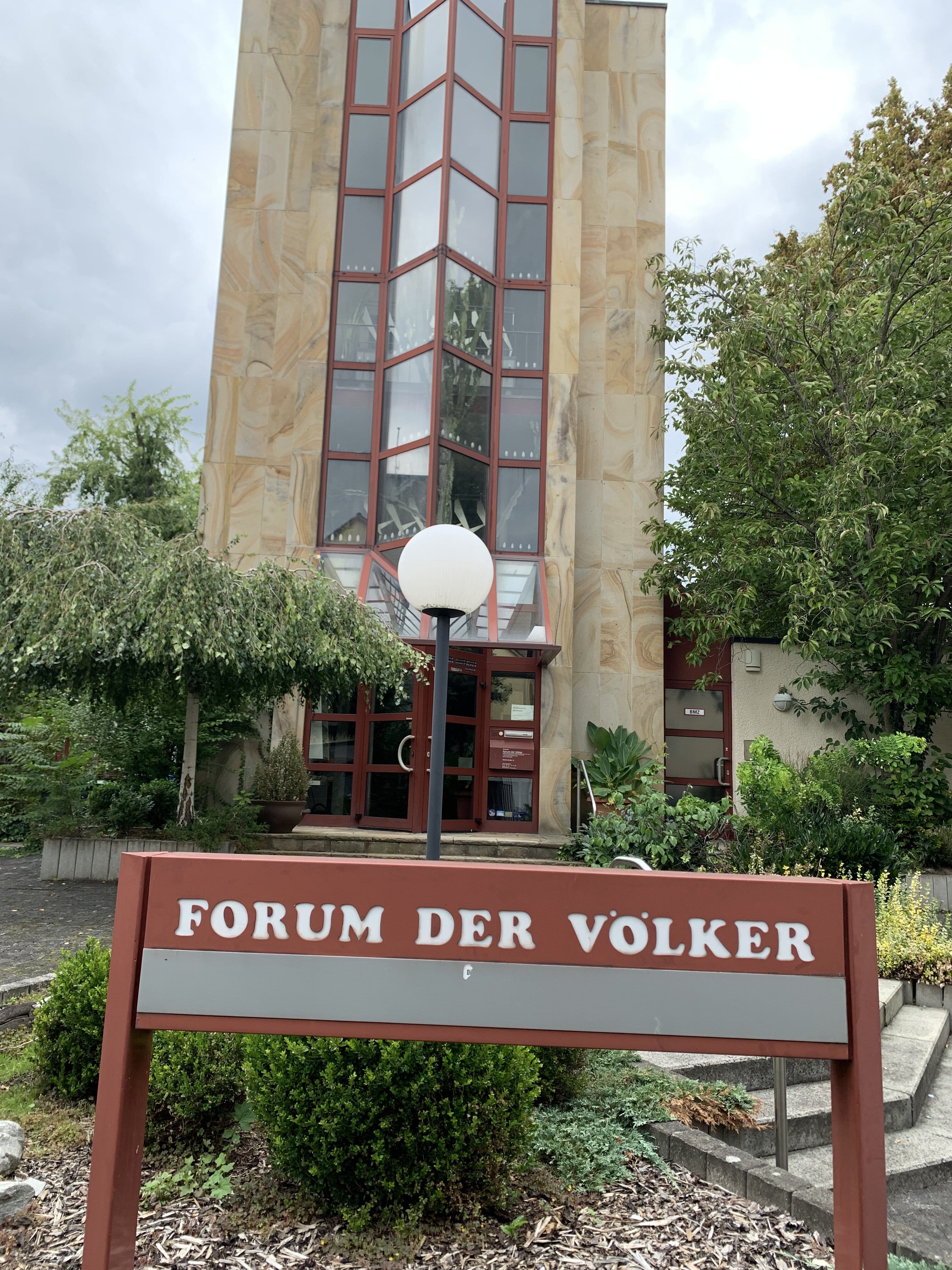 Museum in Werl
Museum’s Foundation and Historical Background
Previously founded as a Missionary Museum, the museum was already soon after its opening rebranded as Forum der Völker. However, the original name already indicated that the objects primarily came from Franciscan monks who gathered them during their missionary activities across various regions to promote Christianity in Germany. These dedicated monks collected a wide array of everyday and ritual objects to provide insight into their missionary work. The museum asserted that the Franciscan monks were continuing a medieval tradition of collecting and depicting foreign cultures, viewing it as their duty to make these objects publicly accessible, especially in the region of Dorsten during that era.
While the focus and intention of the museum shifted soon after the outset, the initial museum was established in an old section of the Dorsten monastery and focused exclusively on collecting missionary objects from the Orient, East Asia, and the Americas. The first objects primarily originated from monks on their missionary missions who either sent or brought these items back. Private collectors also contributed, and their contributions are duly acknowledged in the museum’s official 1987 catalog. It is mentioned that these individuals played an important role in preserving and maintaining the core of the collection, potentially preventing its destruction.
Of particular interest when looking at the museums foundation and early years is a protocol from 1915, which documents the challenges encountered during the museum’s establishment, the criteria for object collection, and the objectives behind collecting and presenting at that time.
Firstly, it clarifies that there was no initial plan to create such a museum. Instead, it developed organically as more objects were acquired by missionaries who grew increasingly enthusiastic about collecting. By 1911, the collection had outgrown four shelves, necessitating a move to larger rooms. The Dorsten monastery was the only place with suffficent space, providing over 200 square meters for the collection.
Secondly, the protocol attempts to explain the purpose of collecting and exhibiting these objects. While anticipating potential opposition to bringing these objects to Germany, the primary goal was not merely to document their missionary work but to preserve these objects and make them accessible to the local people. This accessibility was intended to convey the importance of the missionary mission. The collected objects served as evidence of the “pagan misery” among these cultures, which used “idols, ritual devices, magic spells against demons, and black magic,” and were regarded as morally problematic. In contrast, the collection also included items used by the missionaries to show the ways of conversions to Christianity. While the religions of these indigenous people were described as “pagan misery,” the culture and work of the Christian monks were presented as a blessed culture engaged in salvific work. This was illustrated through images of the monks’ activities and objects used in missionary schools, such as handicrafts crafted by the students, statistical data, and instructional materials.
Thirdly, the museum aimed to include objects that highlighted the positive aspects of diverse cultures. They collected items that they considered valuable from a European perspective while marginalising those they disagreed with. These objects mainly comprised of craftsmanship, including archaeological artefacts showcasing the rich history of various cultures, as well as paintings, silk, wood carvings, and specimens from nature.
As the collection continued to grow over time, the museum in Dorsten was tragically destroyed during the Second World War, prompting the relocation of the objects. Then, a new facility was constructed in Werl, which opened its doors in 1962, allowing the collection to expand further. In 1986, it received a substantial addition in the form of a collection from Franciscan collectors in the Netherlands, comprising approximately 3,000 objects from diverse regions and cultures. (Reinking, 1987, p. 1-12.)
Franciscans missionaries in Dorsten
Several individuals played pivotal roles as primary contributors to the early collection, with missionaries making significant contributions in subsequent years. While private purchases had been made before 1913, a notable early contribution came from Pater Romuald Uhrich, who brought the first objects from Egypt to the museum in 1913. This initial collection was later expanded through the private collection of Dr. von Hebentanz.
In the 1920s, Pater Anastasius Schollmeyer, a Franciscan and an Assyrologue, made an important contribution by providing the museum with the renowned Cuneiform tablet collection. Pater Heinrich Haussle, with assistance from Pater Albert Rittner, procured the collection from Palestine. During the Chinese mission, Pater Vitalis Lange played a crucial role by sending back a massive East-Asia collection. Additionally, Pater Remigius Gotte and Pater Cantus Hanfland completed this extensive collection by sending back a significant Chinese coin collection. The combined efforts of these individuals significantly enriched the museum’s holdings, showcasing a diverse array of cultural artifacts from different regions. (Balthasar, 1921, S. 20ff)
Modern Rebranding of the Museum
Today, there is a concerted effort to reshape the museum’s narrative, moving away from the perception of showcasing non-European cultures as false or pagan, and instead embracing them. The official flyer of the museum emphasises that the objects “offer valuable insights into the daily lives and religious practices of foreign people, spanning from ancient times to the present day.”. Meanwhile, the museum’s website highlights its commitment to fostering dialogue with foreign communities, religions, and cultures.
The official catalog from 1989 states that while the objects were initially used to document missionary work, they are now viewed as artefacts that shed light on foreign cultures. They serve not only to understand but also to foster tolerance by broadening our own limited worldview. To achieve this, specialists from various fields were enlisted to catalog the collection in 1986, and the presentation of objects in the museum has been enhanced to create a more engaging visitor experience.
In 1987, the museum underwent a significant transformation, culminating in its renaming to “Forum der Völker.” This name change signifies an invitation to engage in dialogues with foreign cultures, people, and religions, with the aim of discovering common interests and a shared willingness to learn from one another. This pursuit is driven by the principles of justice, peace, and reverence for the divine creation, recognising that different religions may offer distinct paths leading to a common goal. (Reinking, 1987, p. 13)
Structure of the museum
To grasp the entire “mechanism” of the museum, let’s briefly explore the structure of the exhibition and the museum as a whole.
Upon entering, visitors find themselves in the currently closed museum store, serving as the entrance. Moving forward, there’s a spacious hall that already showcases a few artifacts for observation. The main exhibition follows, forming a circular path.
Entering from the left brings visitors to the room housing the Egypt collection. This space features black walls, intensifying the impact of the exhibited objects. At the center of the room, capturing attention, is an original mummy.
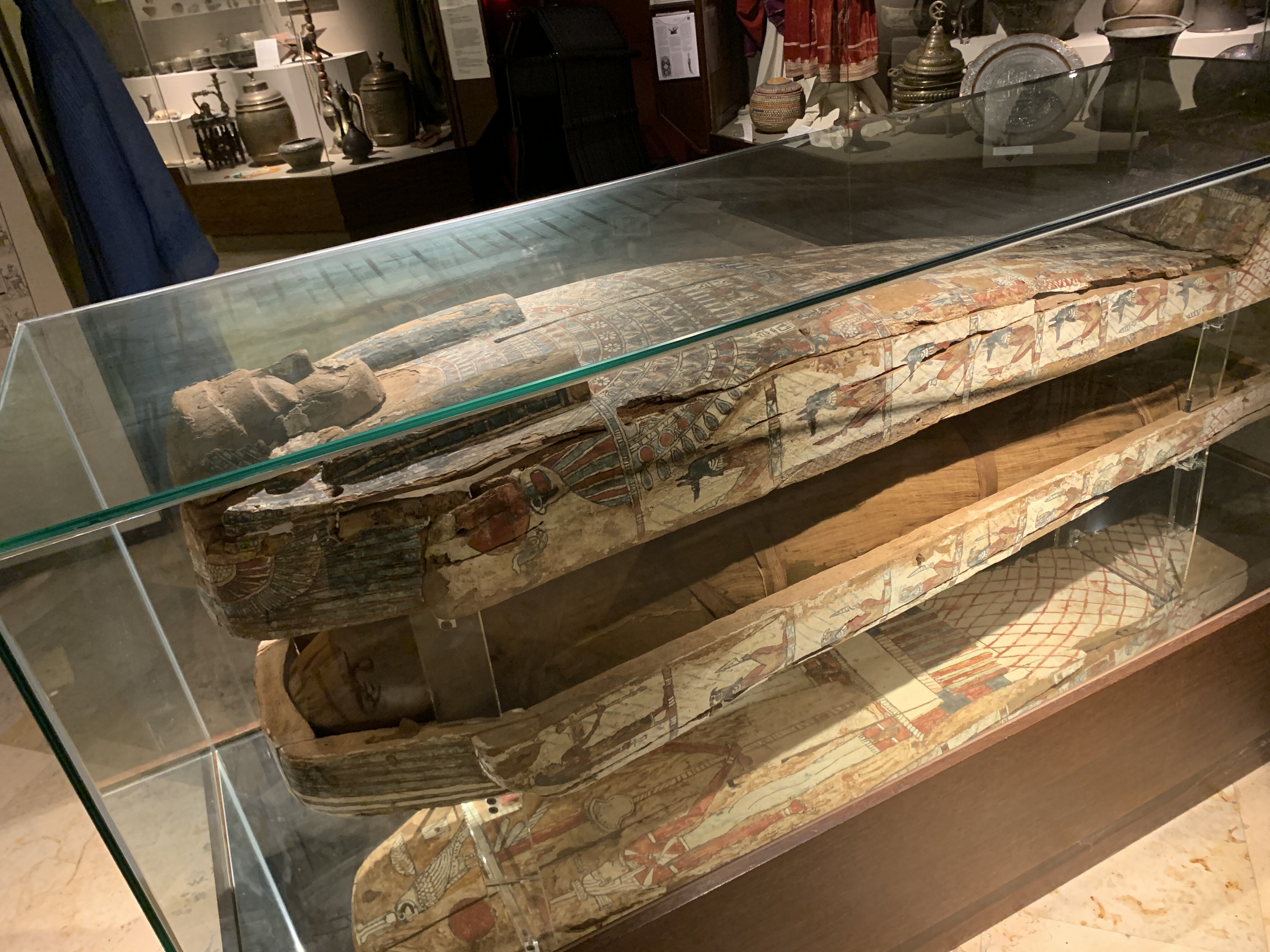 Mummy in Egypt exhibition
Before stepping into the East Asia section, visitors encounter a relatively modest shelf displaying cuneiform tablets. But despite their seemingly unassuming appearance, these tablets carry significant historical and cultural weight, especially for those familiar with the historical backround of Mesopotamia.
Moving into the East Asian section, numerous objects are displayed without extensive protection, giving an authentic and open feel to the exhibition space. The objects reflect the expected characteristics of East Asian artifacts, featuring shrines and religious depictions, among other culturally rich items. This section offers a glimpse into the diverse and intricate world of East Asian art and spirituality.
 Picture of East Asian exhibition
Taking a left turn leads you to the Gandhara objects, serving as a significant starting point for the collection, followed by Chinese and Japanese artifacts. In this section, the walls are painted white, and the objects are displayed behind glass shelves, maintaining a clean and organized presentation.
Continuing the journey, two vibrant rooms showcase Chinese objects, including sizable items like shrines. The Brasilia section, though relatively small in terms of objects, is enriched by a compelling collection of images from the Christian mission there. An actual wooden hut placed within the museum, surrounded by pictures, creates a vivid representation of reality.
Moving on, dedicated sections for African objects follow. The exhibition here emphasizes the objects themselves, with a less colorful backdrop, focusing on categories such as “power, gold, and rituals.” Special areas are designated for East African artifacts. Two rooms are exclusively dedicated to Papua New Guinea, and there is another one solely for Nepal. The varying presentation styles, with some rooms being colorful and playful with numerous pictures, while others have plain white walls without information boards, might prompt questions about the curatorial choices.
Having explored all these diverse areas, you find yourself back in the entrance hall, completing the comprehensive journey through the museum’s rich and varied collection.
 Information board in the entrance