
Buddhist Objects from Gandhara in Werl
In the East Asia section of the Werl Museum, there are 13 objects from Gandhara. Among them, seven are heads of Buddha and Bodhisattva, four are relief figures (one featuring only the upper body of a bodhisattva), one depicts a scene from Buddha’s life, and there is also a horse’s head. These artifacts, originating from Gandhara, Pakistan, date back to 200-500 A.D., and they were acquired from the estate of the German politician Ernst Majonica.
Ernst Majonica
Ernst Majonica was a politician born on October 29, 1920, in Soest, Germany, and he passed away on July 21, 1997, in the same town. During the 1950s and 60s, he was an important member (and also the youngest) of the German party CDU, which he represented in the German parliament. He was one of the few parliament members at that time who focused on foreign relations with East Asia. This led to multiple trips to the region, and he became the spokesperson for foreign affairs in 1959.
Before entering politics, he grew up during the Third Reich and, as a committed catholic, faced challenges under its regime. He studied law but had to interrupt his studies to serve in the war. He was released from imprisonment by the Americans and Belgians in 1946 and completed his studies in 1950, eventually becoming a lawyer.
In addition to his political and legal careers, he was an enthusiastic collector of foreign objects and art obtained during his travels. The Werl museum inherited parts of his collection, including a small collection of the objects from Gandhara. (Beckmann,2008, p. 395-400) His collection also forms the entire collection of the room dedicated to Tibet in the museum, and a total of around 1,000 objects derive from his collection. The inheritance to the museum has been set in a testament he had established years prior to his passing. Sadly, he had already been in poor health, preventing him from providing intricate details regarding the origins and provenance of this extensive mass of objects. (Balke, 2014, p. 10)
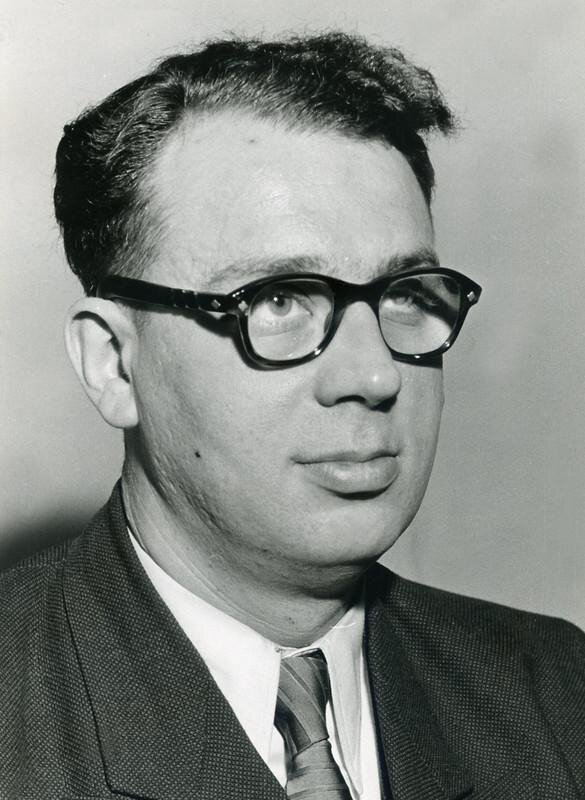
Ernst Majonica
How the objects from Gandhara came to Germany
One of my main aims originally for this project was, to also find out a lot more about the provenance of these objects coming from Gandhara. Which sounded like a lot of fun in the beginning, turned out to be more difficult than expected due to the closing of the museum which currently makes me unable to do research in the museum.
Still, from an lecture being held by Dr. Mai Lin Tjoa-Bonatz on the 06th of July 2023 at the CERES-Palais, Bochum, earlier I found out at least some things: As mentioned before, these objects come from the estate of the German politician Ernst Majonica, which went to the museum after his passing in 1997. It is said that he traded these objects (perhaps in the 70s or 80s) on a travel in Afghanistan against Whiskey - so historical and religious artefacts have been traded for alcohol. Unfortunately, there was not more to easily find out.
What the archive can possibly tell us
The lack of access to the archive indeed leaves many intriguing questions about the Gandharan objects from the Werl Museum. To delve deeper into the research, obtaining specific details about the trading, including exact dates and locations, would be highly beneficial. Unfortunately, even Ernst Majonica’s political diary fails to provide insight into the precise years of his travels to Afghanistan.
A myriad of unanswered questions surrounds these artifacts:
- Origins and Circumstances:
- Why were objects from Pakistan traded in Afghanistan?
- How did these objects end up there, and under what circumstances?
- Were they discovered during an excavation, intentionally removed from something of historical value, or traded without regard to their significance in the Buddhist heritage of Pakistan?
- Was there an intentional effort to deny the Buddhist history of the region?
- Intentions and Awareness:
- Did the trader recognize the historical and cultural significance of the objects, or were they sold without a full understanding of their age and value?
-> Regardless of the buyer’s intention, it is clear that these objects have commercial value and would enhance the collection of Ernst Majonica or future owners.
- Majonica’s Motivations:
- Why did Ernst Majonica desire to acquire these objects?
- Did he recognize and appreciate their importance in preserving Buddhist heritage, or did he view them as simply enlarging his collection?
-> Given Majonica’s health condition when he declared his estate, it remains uncertain if he was aware of the circumstances of the sale, the legal aspects, and the challenges involved in bringing these objects to Germany.
Exploring these questions could unravel the intricate history behind the acquisition of these Gandharan objects, shedding light on the motivations of the traders, the awareness of the buyers, and the broader context of their movement from Pakistan to Afghanistan and eventually to Germany.
Why do we want to answer those questions ? - Provenance Research
But why do we even want to have an answer to these questions, why can’t we just enjoy the current presence of these objects in the museum on their own? This can be answered when defining that answering these questions is Provenance research. But what is that?
“Provenance research interrogates how museum objects were collected, acquired and sometimes misappropriated, and shines a light on the often circuitous paths they took to end up in the museum. It deals with the contexts behind changes in possession and ownership, from the creation of an object to its inclusion in the collections. The work of provenance researchers highlights the forgotten stories behind the objects. These stories are almost always fascinating, but are sometimes also bizarre or shaped by violence.” (“Provenance research.” Staatliche Museen zu Berlin. Web. 05 Nov 2023 [https://www.smb.museum/en/research/provenance-research/])
So Provenance Research does exactly this, what I am currently not able to: it would answer where the objects originate from, who owned them, when and under which circumstances, and all the other questions listed before.
But why is it - or why did provenance research become so important? While Germanys aim in the 1990s was to find out more information about art, cultural objects and historical artefacts that have been seized and stolen during the Nazi rule from 1933-1945 as a result of racial, political and religious persecution, so that those can be returned to the rightful owner.
While the history and the restitution of stolen art, illegal trading and problematic holdings therefore plays a major part in why for example museums do provenance research, some other reasons also became important as time passed. Provenance research namely generally can enhance the collection of a museum by gaining more information, because then it can possibly tell us more about history and art history from getting to know more about certain objects.
In many cases of German museums, it might even serve to reflect the collections which emerged during the colonial rule, and how the museum today should handle the ownership of these objects.
Additionally, it also benefits the object itself - Provenance generates an authenticity and clears the question of ownership. (Wonisch, 2018, p. 40-42)
In the case of the objects from Gandhara, different advantages of knowing about the provenance can be listed: It could possibly tell us about how the Buddhist heritage was being handled during the time of the trade. It could also tell us why Ernst Majonica wanted to have them - did he see their value, so did he know about the Gandharan heritage (or did he even only wanted them because they looked “greek”)?
The place of the founding could also hint places to get to know more about Buddhism in the area as through archeological excavations. And as being said, it maybe would increase their value and the dedication of portraying them more accurately within the collection, as it will be talked about in the next chapter. So it can be hoped, than someone will be able to do so when the museum reopens, so that the history of these objects will be saved from forgetting and the value of their heritage and history would be appreciated .
Inclusion within the Museum - do the objects fit in? How are they presented?
When looking at the collection of Gandhara in the museums, some questions need to be observed and answered, as how the objects are included in the museum, how they are presented and also what function do they even fulfil in the entity of the collection. From my first observation on, several noteworthy aspects emerged regarding the presentation of the objects in the museum.
Firstly, a conspicuous absence of including them is evident on the museum’s flyer. While it provides information about various regions, including Egypt, Islamic culture, China, Japan, Tibet, Southeast Asia, Africa, and Brasilia, there is a lack of specific details about Gandhara. This omission may stem from the relatively small number of objects from this region in the collection, but actually is because. the Gandharan collection was only included after the last update of the collection. Therefore, also the flyer does not offer information about Buddhism and South Asia.
This lack of representation is also reflected on the museum’s website, which was last updated in 2022.
Link to the Website of the museum
The presentation of these objects is equally intriguing. Since there is no dedicated area for Buddhism or South Asia, objects from Gandhara are somewhat erroneously placed at the beginning of the section featuring objects from East Asia.
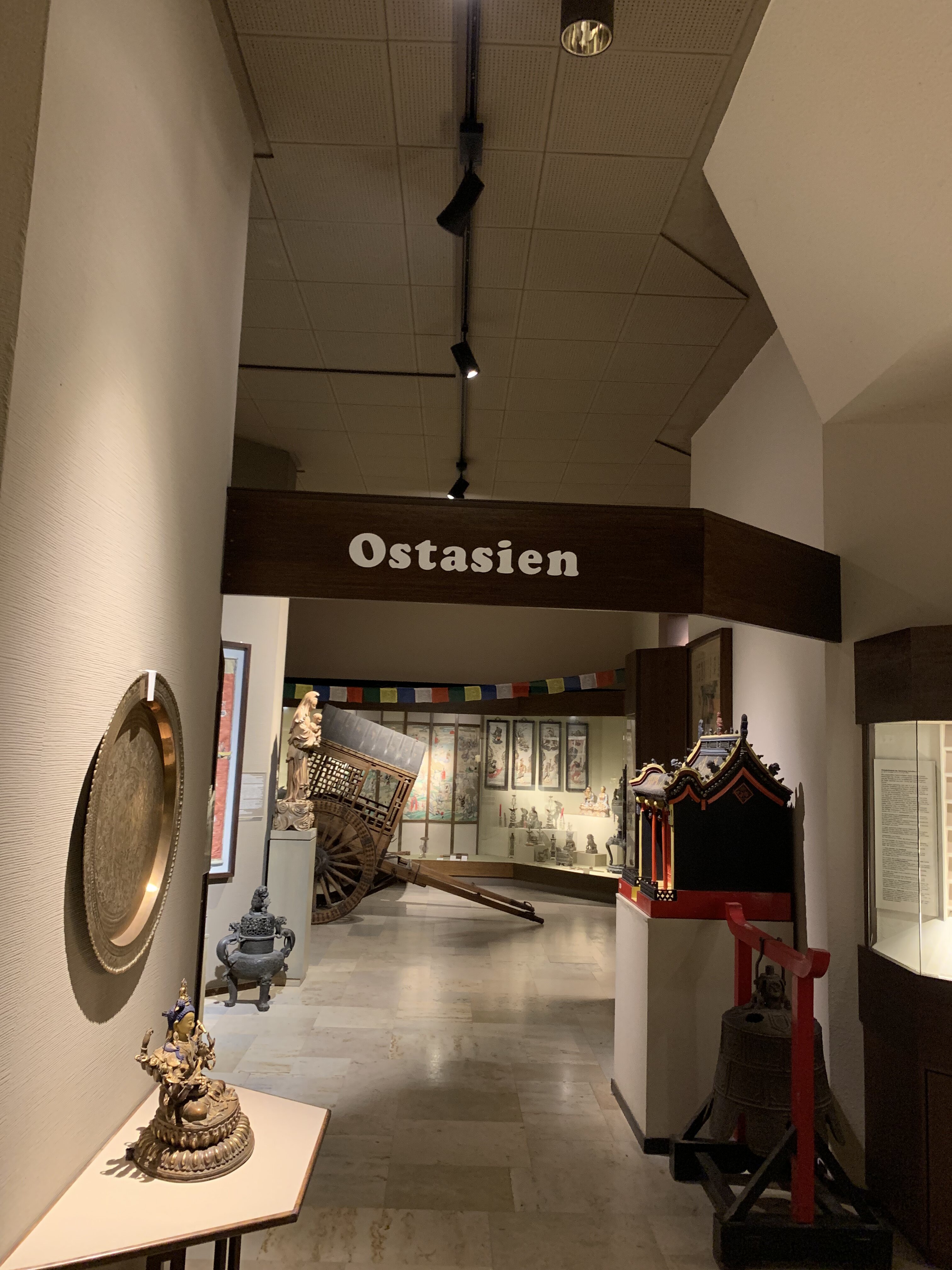 Entry to the collection
Unfortunately, there is inadequate separation between the labels for these objects and those from East Asia, aside from a small note indicating that they are from Gandhara, Pakistan.
The collection includes 13 objects showcased in glass cabinets, though there is room for improvement in terms of lighting. Nonetheless, each object can be observed. Smaller objects share a raised white shelf against a brownish wall, while larger objects have their dedicated shelves. One object is inexplicably hanging on the wall without a label providing essential information, while the twelve others are provided with those information.
There are two notable criticisms regarding the labelling, as I tried to think of ways to improve those critics.
Firstly, the numbering of objects goes from one to fourteen, but object number 11 does not originate from Gandhara; instead, it is attributed to Nepal or China. This arrangement can be misleading for viewers who may not notice the discrepancy. It would make more sense for this object to be placed elsewhere in the collection alongside Chinese objects or be designated as number 14 to maintain a clearer distinction between Gandhara and the other regions.
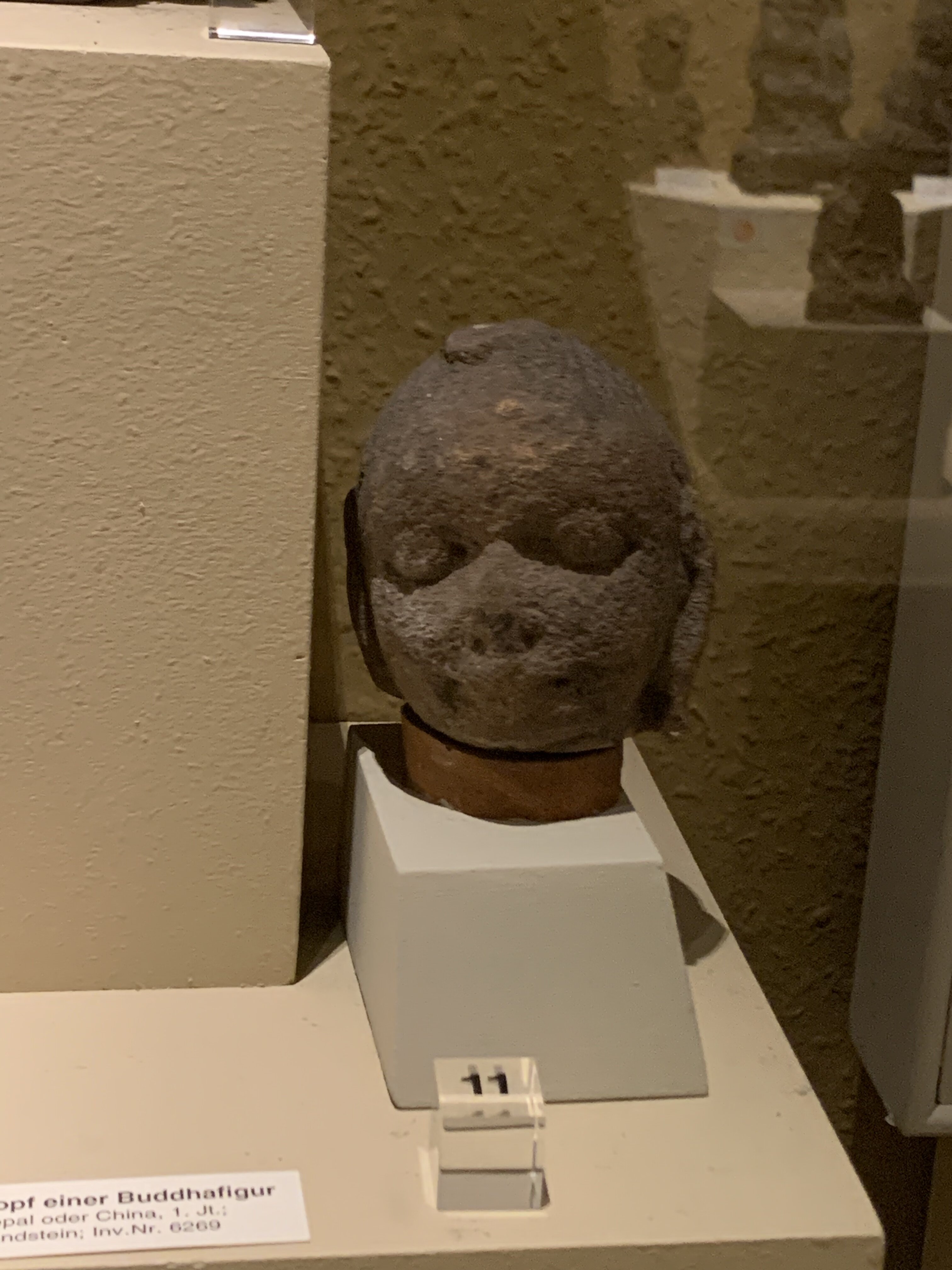 Buddha head from China or Nepal
Secondly, after object 14, the numbering continues, showcasing Buddhist objects from East Asia, without a visible differentiation between these vastly different regions. To enrich the collection, I could imagine a small seperation of these objects, simply by providing information about the differences of Buddhism in Gandhara and Eastasia, perhabs even explaining the connection of both areas.
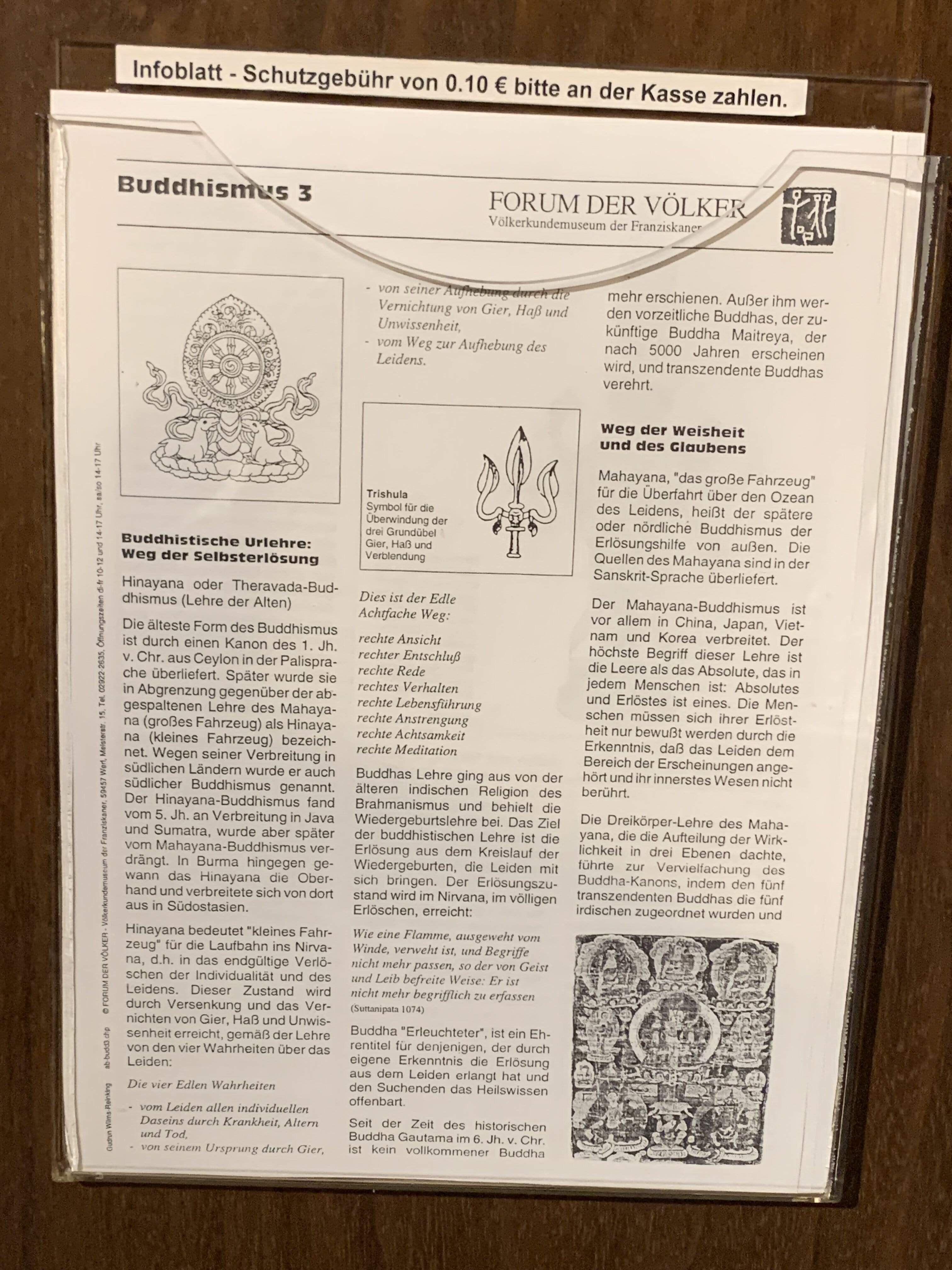
In this section, a printed piece of paper is available for a fee of 0.10 euros, providing more detailed information about Buddhism, which is notably absent from the labels on the objects. This paper offers a good amount of general information, beginning with Theravada Buddhism (which is a somehwat outdated representation) and explaining the Four Noble Truths and the Eightfold Path. It then delves into Mahayana Buddhism, crucial because of its prevalence in East Asia. The third form of Buddhism, Tantra, is also briefly mentioned, characterised as a mystical and occult variant of Buddhism with secret religious texts and mantras. While this paper provides a general and not bad overview of Buddhism, which could benefit from updates since it provides a slightly outdated representation of Buddhism, it notably neglects to mention Gandhara, missing an opportunity to use objects from the collection as examples to elucidate the different developments of Buddhism. Therefore, a small update to make the paper more suitable to the connection could give a huge improvement to the collection.
Lastly, the official museum catalog published in 1989 includes objects from various regions, but none from Gandhara, since at that time they were not included in the collection yet.
In conclusion, it appears that the museum’s various communication mediums, including the flyer, website, information boards, and printed materials, as well as the presentation of the collection itself, fail to adequately represent Gandhara, but that could be improved quiet simply to portray the Gandharan objects worthy of their worth.
While at least the objects have been included in the museums collection, the curators appear to have overlooked the challenge of categorising these objects or did not prioritise maintaining a clear distinction between Gandhara and East Asia, which could be something to face and change in the future.
While the objects themselves are presented satisfactorily and some information is provided, such as the information paper on Buddhism, it seems like the museum just tried to include these objects at all cost without taking proper care about the background information, because they “sell well”, and maybe tried to compensate that by at least educating about Buddhism, and presenting the objects next to other buddhist artefacts, which of course is not a bad way to portray buddhist objects, it just needs little adjustments.
Nevertheless, there is still a lack of comprehensive education about Gandhara and its Buddhist history, especially for viewers with little or no prior knowledge of Gandhara since the collection is detached from the given information, and when it comes to answer the question, what function do these objects fulfil for the collection of the museum, it’s easy to say - none, they seem to be included simply because they’re there and sell sell, and because they improve the collection by being older than the average objects collected by missionaries (which mostly only date back 150-100 years) and because they’re archeological objects, as the majority of objects in the museum is not, and additionally they fit the narrative of portraying anything Buddhist.
Talking about the pros and cons of how the objects are presented, it is excited how the curators would decide to portray those challenging but rich objects after another upgrade of the collection (somewhen in the future)!
What do these objects tell us about Buddhism
Given that these objects are essentially 13 random items acquired through accidental trade rather than a deliberate effort to represent Gandhara, exploring what they can reveal about Buddhism from their period proves to be a challenging yet intriguing task. Upon closer inspection, it becomes apparent that many of the objects are not particularly extraordinary; rather, they seem to be small fragments likely broken off from larger pieces. Examples include object 2, a horse head, and objects 4, 5, and 6, which are small relief heads. Despite their modest size, these items still carry significant cultural heritage.
Object 1 is also a small relief head, specifically depicting Buddha, similar to the larger Buddha heads represented by objects 10 and 12. Notably, these Buddha heads exhibit variations, suggesting either a lack of uniformity in portraying Buddha in the region or the depiction of different Buddhas, potentially recognizing previous Buddhas before Buddha Sakyamuni.
Similarly, Bodhisattva representations present a similar case. Object 3 is a small Bodhisattva head, while object 7 depicts the entire body of a Bodhisattva, and object 13 shows only the head and upper body. The variations in facial features, hair, and clothing suggest different styles or the portrayal of distinct Bodhisattvas. If the latter is true, it signifies the belief in different Bodhisattvas in Gandhara during that time, providing evidence of the coexistence of Mahayana alongside Theravada in Gandhara, likely emerging in the late phase of Gandharan art production between the 2nd and 5th centuries.
The final noteworthy object is number 11, depicting a scene from the Buddha’s life where he preaches while seated in the lotus position surrounded by devotees. These scenes, emerging in the first century A.D., represent some of the earliest artistic depictions of the Buddha and underscore the significance of early Buddhist art in Gandhara. Such scenes from the Buddha’s life were deemed crucial for Buddhists and were commonly featured on stupas.
In conclusion, while these objects may not appear exceptionally special compared to other collections, their importance lies in highlighting what held significance for Buddhism in Gandhara. The depiction of scenes from the Buddha’s life showcases the early veneration and art-making in the region, while the variations in Buddha and Bodhisattva representations provide insights into the diversity of beliefs, potentially indicating the presence of Mahayana Buddhism in Gandhara. A closer examination by an expert could potentially yield more insights, such as identifying production facilities in Gandhara and understanding the attachments of smaller objects.